



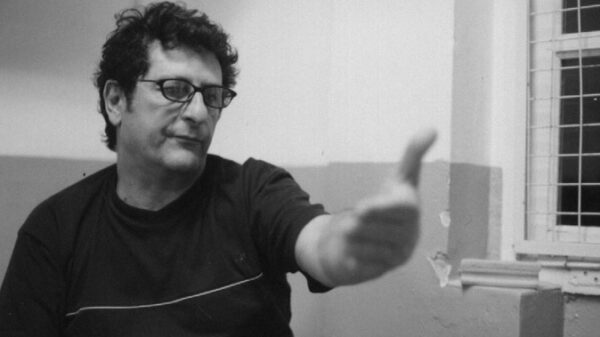








Paul Driessen – Nimega, Holanda.
The One-Minute Memoir (Short) (segment «Places where I ate») (2020); Cat Meets Dog (Short, 2015); Oedipus (Short, 2011); The 7 Brothers (Short, 2009); Des histoires pas comme les autres (Video, 2006); The Dutch Films of Paul Driessen (2004); Oh what a Nico (2004); 2D or not 2D (2003); The boy who saw the Iceberg (2000); 3 Misses (1998); The end of the World in four seasons (1995); The water people (1992); Sunny Side Up (1985); Oh what a knight (1982); On land, at sea and in the air (1980); The killing of an egg (1977); Air! (1972); Le bleu perdu (1972); The story of little John Bailey (1970); entre otras.
(6 de Marzo de 2011 15:10) ¿Por qué filmo?
Ya de niño dibujaba caricaturas que retrataban situaciones divertidas. Más tarde, cuando crecí en los 50’s y 60’s continué dibujando caricaturas, a pesar que en Holanda, donde yo vivía, no tenía tradición en el tema. Enviaba mis caricaturas a todo tipo de diarios y revistas en Amsterdam, Londres, París y Nueva York (olvidé Buenos Aires), pero no tuve mucho éxito vendiendo mi trabajo. En ese momento yo no sabía nada sobre animación, hasta que un día, de casualidad, escuché sobre un estudio pequeño de animación para comerciales no muy lejos de Amsterdam. Apliqué para un trabajo, y gracias al estilo de mis caricaturas, fui contratado por la cabeza americana del departamento: Jim Hiltz.
Por mi experiencia escribiendo historietas descubrí que me resultaba fácil encontrar ideas para cortos de animación. Cuando el estudio quebró en el ’67, fui invitado a Londres, a trabajar en Yellow Submarine, una película que abrió los ojos de muchos de nosotros hacia la animación no tradicional. También su rebelde director George Dunning, era un animador canadiense que había trabajado a las órdenes de Norman Mac Laren, en la National Film Board de Canadá, y él me mostró y me habló sobre la animación hecha en la Filmboard.
Tuve suerte que mis ideas fueran aceptadas en la Filmboard, así que me mudé a Canadá y empecé a hacer mis propios cortos animados. Cuando descubrí la animación en el ’64, fui cautivado por la gran cantidad de posibilidades que daba el medio: además de dibujar movimiento con un determinado estilo en un determinado espacio, había un tiempo y un espacio disponible para uno poder contar sus historias. Y la música y el sonido para ilustrar o enfatizar las ideas que uno quería atravesar.
Lentamente desarrollé mi curiosidad explorando el medio, cuán lejos podía uno llegar, en mi caso, siempre contando historias en forma de caricatura.
Nunca estuve interesado en las técnicas, siempre me atenía a mis historietas animadas, sintiendo, aún hasta el día de hoy, que hay mucho que se puede expresar en dibujos simples, si uno tiene las ideas precisas sobre qué quiere mostrar en la pantalla.
Usé las técnicas de reencuadre, pantalla dividida, multipantalla, puse las cosas patas para arriba, siempre encarando una nueva aventura animada.
El año pasado cumplí 70, pero todavía tengo un par de experimentos que me gustaría convertir en películas. Por suerte, mi estilo de dibujo tiene un trazo ondulado, tanto que incluso cuando mis manos se vuelvan temblorosas, seguiré siendo capaz de producir.
(March 6th 2011 03:10pm) Why do I make film?
As a little child I already drew cartoony drawings depicting funny situations. Later, when I grew up in the 50’s and 60’s, I continued drawing cartoons, although Holland, where I lived, had not much of a cartoon tradition. I sent my cartoons to all kinds of papers and magazines in Amsterdam, London, Paris and New York (I forgot Buenos Aires), but was not very successful selling my work. In that time I didn’t know anything about animation, though until one day, just by accident, I heard of a small commercial animation studio not far from Amsterdam. I applied for a job and, because of my cartoon style, I was hired by the American head of the department: Jim Hiltz.
I discovered that, because of my cartoon story writing experience, it was easy for me to come up with ideas for short animated films. When the studio collapsed in ’67, I was invited to London, to work on the Yellow Submarine, a film which opened the eyes of many of us to the non-traditional world of animation. Also, its maverick director, George Dunning, was a Canadian animator who had worked under Norman Mac Laren at the National Film Board of Canada and he showed me and told me about the animation done at the Filmboard.
I was lucky enough to get my film ideas accepted at the Filmboard, so I moved to Canada and started to make my personal animated shorts. When I discovered animation in ’64, I was intrigued about the wide expanse of possibilities of the medium: next to drawing movement in a certain style in a certain space, there was also timing and pacing available to tell one’s stories. And sound and music to illustrate or enhance the ideas you wanted to get across.
I slowly developed my curiosity exploring the medium, how far one could go, in my case, always telling cartoon-like stories.
I was never interested in techniques, I always stuck to my drawn cartoons, feeling, even up to this day, that there is so much left to expess in simple drawings, if one has the right ideas for showing it on the screen.
I used framed-in, split-screen, multi-screen (even image-less) animation, turned things upside down and animated backwards, each time plunging into another adventure.
Last year I turned 70, but I still have a couple of experiments I’d love to turn into films. Fortunately, my drawing style employs a wiggly line, so even when my still steady hands will get shaky, I will still be able to perform.